


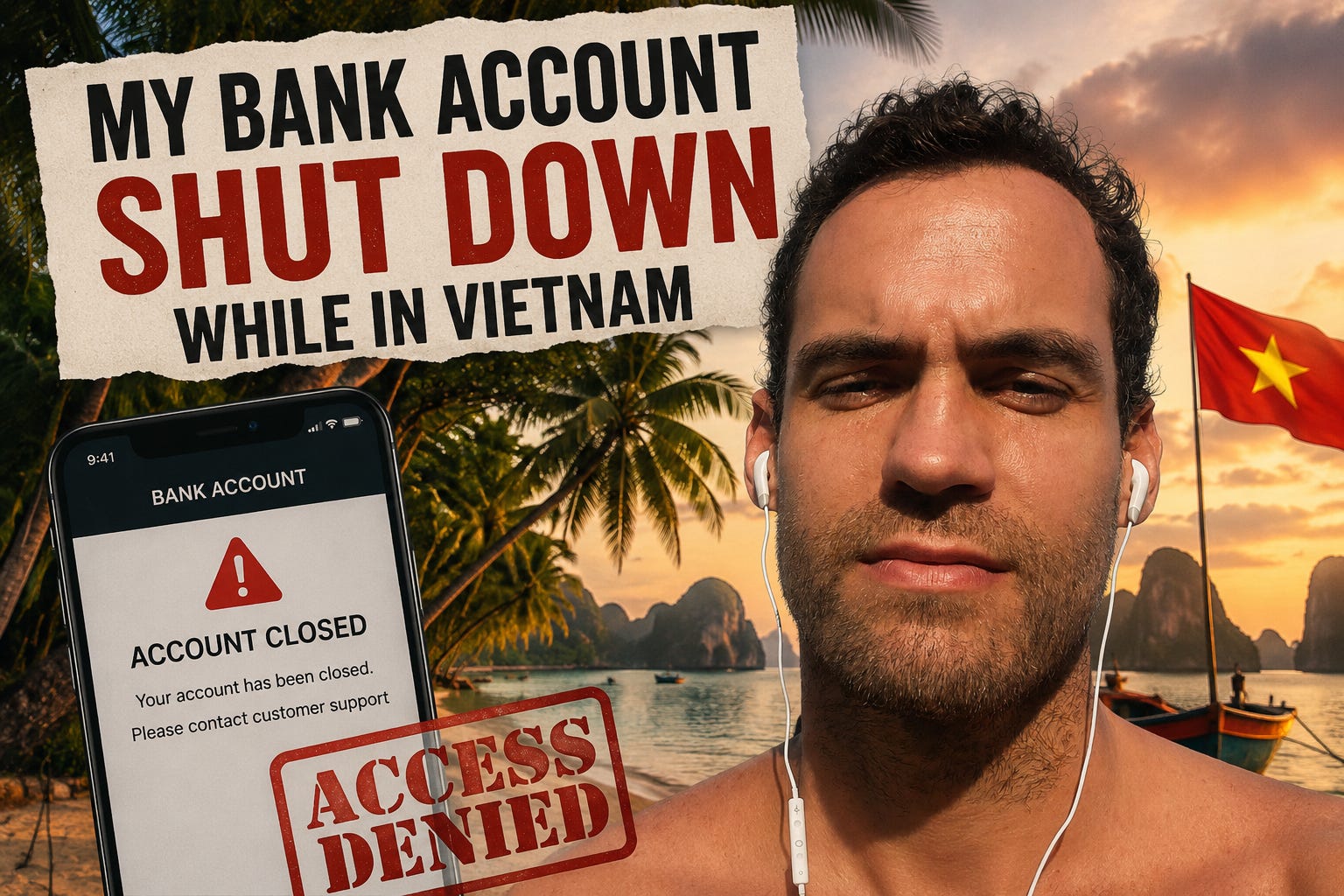
My debit card stopped working at an ATM in Nha Trang on a Tuesday afternoon. I assumed it was the machine. Tried another one. Same result.
Before I had fully registered that something was actually wrong, I sat down at a local cafe and ordered a coffee and a muffin. Four dollars. When the bill came I went to pay and they only accepted cash. No problem, I thought, they had an ATM inside. That one did not work either. I was now sitting in a cafe in Vietnam with a $4 bill, no cash, and a card that apparently did not work anywhere. I ended up convincing them to hold my phone as collateral while I walked back to my apartment to get the last forty US dollars I had. On the way back I found a Russian guy on the street doing informal currency exchanges and converted the cash into Vietnamese dong on the sidewalk. Paid the bill, got my phone back, and sat down to figure out what was actually happening.
Turns out my bank had shut down my account completely. No email, no warning, no call. Just gone.
The reason was almost funny in hindsight. I had been using a VPN to watch Netflix shows and sports games that were not available in Vietnam. Nothing illegal. Just accessing platforms I already paid for. The problem was that I would pull cash from an ATM in Nha Trang and then, because the VPN was still running, log into my account from what appeared to be New York. To the bank’s fraud system, someone in Southeast Asia was draining my account while I was simultaneously logged in from Long Island. They made a decision and they made it fast.
Because the account was fully shut down I could not go through normal customer service channels. No membership line, no app support, nothing. I had to work through the general public avenues, which took time, but eventually I got in front of a customer service agent who was actually helpful. Setting up a new account with the same balance and information was straightforward. That part was fine.
The painful part was the debit card.
They could not reactivate my existing card. They had to mail a new one from New York to Nha Trang, Vietnam, which is apparently not a common shipping route. DHL tracked it as far as Ho Chi Minh City and then handed it off to an independent courier for the 400km journey north. From that point on the tracking was essentially a suggestion. I had to guess when it would arrive and wait in the lobby of my building. I never guessed correctly. We eventually sorted it out over email and agreed to leave it at the Nha Trang post office. I picked it up six weeks after it was sent.
In the meantime I was not completely stuck. My credit cards still worked and I had connected them to the new account so I could pay them off as I went. The main inconvenience was cash. Vietnam runs heavily on it. Before walking into any restaurant or shop I had to check first whether they took cards, which in a lot of places they did not. It was annoying. It was not a crisis.
And that is the actual point of this story.
Losing bank access on the other side of the world sounds like the kind of thing that would end a trip. If I had read this happening to someone else before I left, I probably would have filed it under reasons not to go. The reality was that I adapted, figured it out one step at a time, and it barely affected my day to day after the first week.
Tim Ferriss has an exercise in the Four Hour Workweek called fear setting. The idea is to take whatever worst case scenario is stopping you from doing something and actually play it out logistically. Not vaguely fear it. Write it down. Map it out. Ask yourself if you would survive it and what you would actually do. The answers are almost always less terrifying than the feeling.
Solo travel does that to you in real time. The situations that sound like disasters from home are just problems when you are in them. And problems have solutions.
Consider Subscribing for more stories and tips that may help your journey.
Yep. You understand the fraud tools. Some are more sophisticated than others. I used to notify the bank when I was getting ready to travel, but with the new tools, that's not ever really a thing with a lot of banks now.